
The Whole Child: Dads Early Engagement
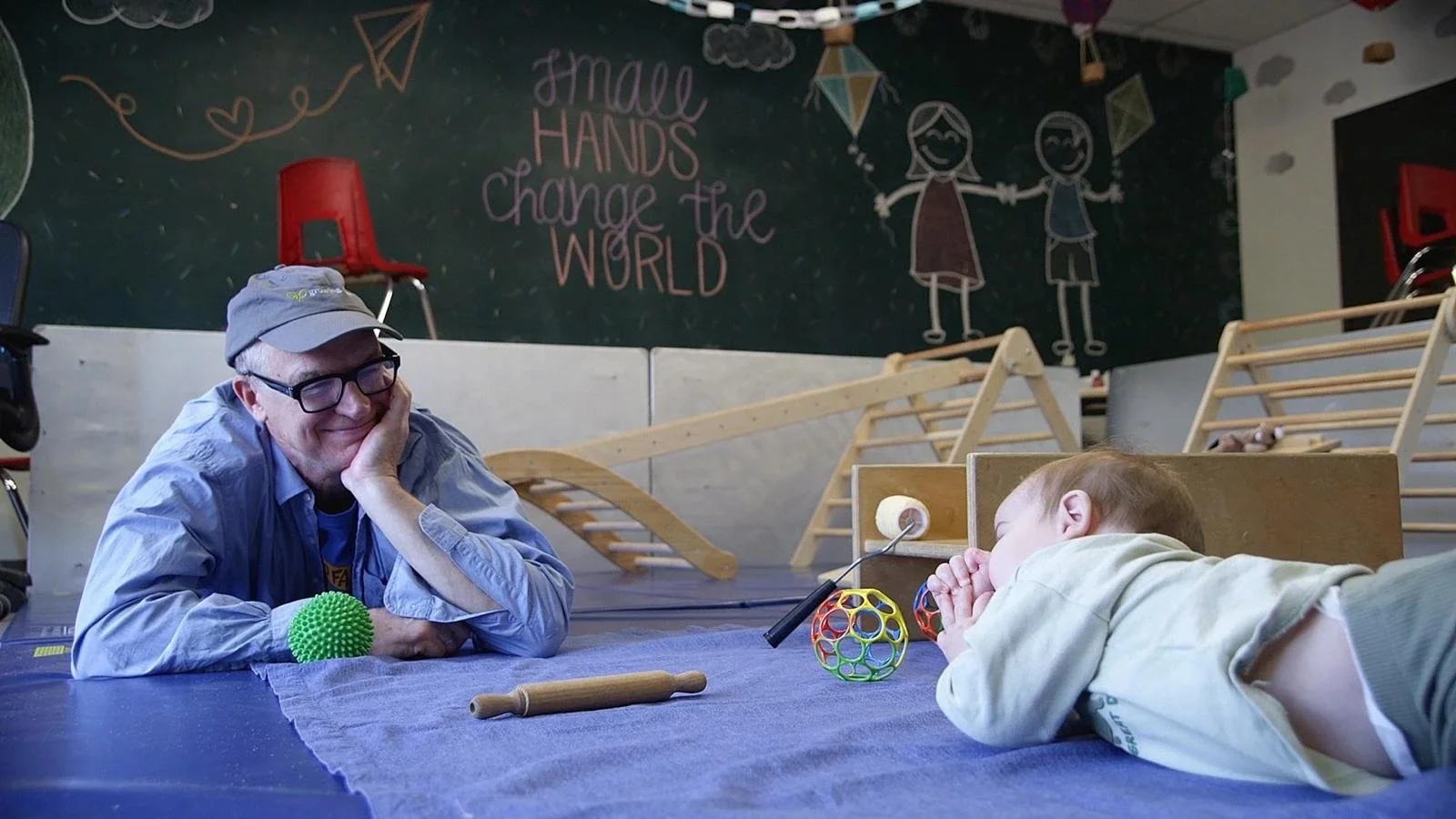
Twenty-two years ago, when Ben Swett’s wife was pregnant, he found himself facing an unexpected crisis. “I was a business guy,” he says. “My relationships with clients, colleagues, and customers defined me. But how do I have a relationship with one of …. these?”
One of “these” of course, was his unborn child. And this honest question redirected the rest of his life.
Today, at 65, Ben is the founder of Early Engagement, a movement grounded in research highlighting the importance of a child’s first three years of life, and empowering parents with simple tools to engage effectively with their babies and toddlers.
Ben’s transformation began with curiosity. He immersed himself in the work of Emmi Pikler, a Hungarian pediatrician whose respectful, observation-based approach to infant development posited that babies are competent from the start. “Her ideas seem radical at first, but are actually uncomplicated and wildly profound.”
Intrigued, Ben traveled to Pikler’s Institute in Budapest. “I needed to see where this came from.” What he discovered was not parenting “hacks,” but a philosophical reorientation: slow down, observe, trust the child.
Back in Los Angeles, he drove all over the city attending Resources for Infant Educators (RIE) classes with his daughter, studying under respected educator Elizabeth Memel. Eventually, she trained him to lead classes himself.
In 2008, when the financial crisis wiped out many of his company’s customers, Ben faced another turning point. Instead of trying to hold on and eventually rebuild his business, he stepped fully into early childhood work. “This is what I’m doing for the rest of my life,” he decided.
An MBA graduate of the University of Chicago, Ben began applying strategic thinking to the smallest humans. “The most profound return on investment,” he says, “comes from investing in babies and toddlers.”
He became involved in the Santa Monica Early Childhood Task Force and serves on their steering committee, as well as co-chairing smmusd’s early childhood advisory committee, as well as other child development boards since. He’s presented on father parenting at state and national conferences. But his most visible work happens on the floor—literally.
At the heart of Early Engagement, “Dad Time” gatherings are free Saturday morning meetups at Virginia Park in Santa Monica. Dads relax and hang out with other dads. Moms get a break. Babies crawl, climb, wobble, and explore in a carefully prepared space.
But this isn’t a typical “Mommy and Me” class with dads swapped in. Mothers and fathers parent differently, and that’s not a flaw, it’s an asset. “Men instinctively challenge their kids. Moms instinctively protect their kids. Both are essential,” he says. “And that just one source of conflict that’s baked in.”
“I don’t do this for dads,” Ben says plainly. “I do this for people who haven’t yet hit their third birthday, which sometimes I have to make adults uncomfortable.” The room has rules: no directing the child, no interrupting their focus, no meaningless questions.
No constant “Be careful!” repeated to a climbing toddler. “When a kid is climbing and you say, ‘Be careful, be careful,’ what is the kid learning?” Ben asks. “They’re learning danger is everywhere, that you should never take a risk, and that their caregiver doesn’t trust them.”
Instead, adults are encouraged to slow down and see learning happening. If two toddlers struggle over a toy, the first step is to pause. Then, let the children attempt to navigate before stepping in.
“We adults succeed by living in and for the future,” Ben explains. “But young children can only live in the moment.” He urges parents to use this as both a practical fact and spiritual practice. “If you’re really seeing the world through your child’s eyes, it’s like a meditation class.”
He pushes back gently against helicopter parenting and also against cultural narratives that sideline fathers in early infancy. In conversations about paternity leave—such as those raised by Jessica Grose in the New York Times—Ben suggests fathers may connect most deeply not in the first 12 weeks (which he calls “the larval stage”) but a few months in, when baby and dad are both ready to connect.
“Men connect with their babies through play,” he says. “And babies connect with their dads the same way, starting at around 3 month olds. That is when we want the dad to show up, and when he and the baby light up.”
Still, he argues that fathers should be invited into the process even earlier. His dream? Prenatal sessions for men, in the weeks before birth.
“No one ever says, ‘How was being born into fatherhood?’” Ben says. No one says “Get in There!” “Men say “I’ll teach the kid to ride a bike when he’s six.’ No. Learn about what pretty much every other dad has faced. Learn how and what your kid is learning now. And then, Get your cheek on the floor.”
By that, he means physical presence. Eye level. Partnership.
One of his core principles is becoming “partners in care”—the idea that a child and each parent are collaborators, that neither is commander or subordinate.
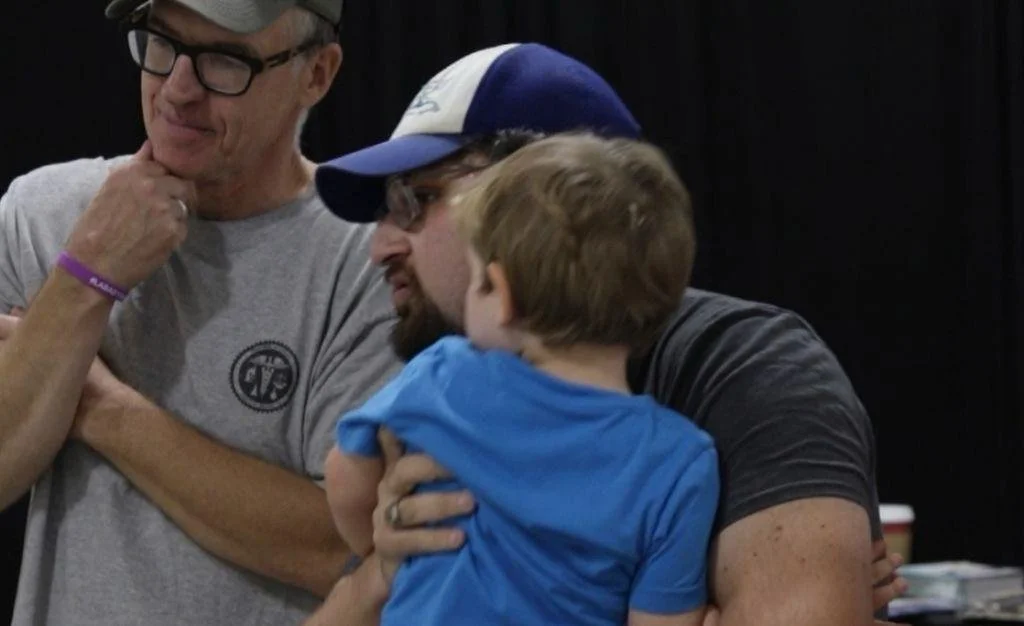
Ben often films everyday parenting moments, such as a toddler grabbing and a father intervening. Then, he’ll “work tape” with a dad, looking closely at replays like a sports coach. The goal is not judgment but awareness.
“It’s so easy when you have that awareness, and can set things up from the start,” he says. “There’s tough stuff going on at age 2: dealing with one’s feelings, others, staying regulated, and aware. The mental tools you get at the start are your foundation - it’s best to get that foundation solid in the beginning, versus when you’re six. Or fourteen. Or twenty-seven, or forty-two.”
When he first meets a parent, Ben stresses that before age three, children are building their social, emotional, and cognitive foundations: a base of confidence, curiosity, resilience and self-knowledge that everything else rests on that base.
Adults, meanwhile, often act on instincts that make sense in adult life but not in a toddler’s. We ask a lot of questions of the people we’re caring for: “Are you warm enough?” “Do you need coffee?” But the child doesn’t share the adult framework. “When you overhear conversations between parents and kids,” Ben says, “imagine what the kid’s hearing.”
Though Early Engagement has an Instagram and YouTube presence, Ben remains skeptical of social media. He dreams of scaling “open-source Dad Times” through video—spreading the philosophy without commercializing it into another parenting product.
The mission, always, returns to the child.
“Who is the most powerful person in your kid’s life?” he often asks. “Once you recognize that, everything changes. How you set boundaries. How you respond. How you help them learn through their choices.”
In a culture obsessed with optimizing résumés and milestones, Ben’s work underscores the basics. Slow down, get down on the floor, follow rather than lead. Immerse fully in this fleeting, meditative, magical moment. Your child is only this old today. Observe more, worry less. The smallest humans are already whole.
Sign up to join in, swap ideas, and attend the next Saturday Dad Time!
Jessica Cole